Published Nov 11, 2025
by Markus Rummel. At AI Endurance, your optimized training plan has always been built on data — not guesswork. We start by crunching the numbers: analyzing your recovery, availability, and long-term progression to create an efficient, evidence-based plan.
Now, we’re adding a new layer of personalization: the Plan System Prompt.
This new feature lets you directly tell our LLM-based AI agent how you want your training to evolve — in your own words. After the base plan is generated, you can add a prompt that adjusts your workouts according to your specific goals, preferences, or upcoming events.
The agent has full access to tools that can:
You can be as creative or as specific as you like. For example:
"Replace some Threshold workouts with Over-Under workouts"
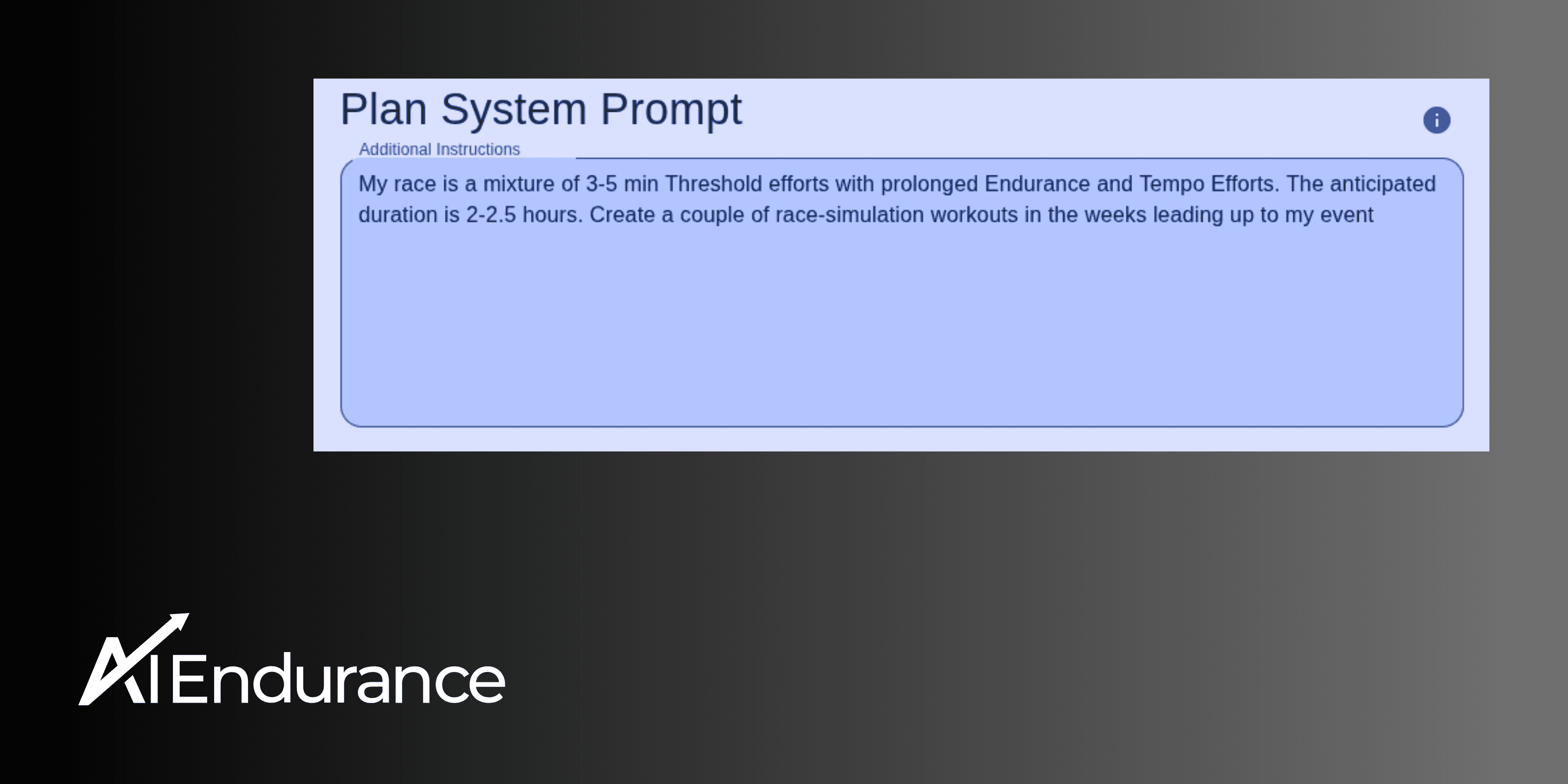
"My race is a mixture of 3-5 min VO2Max efforts with prolonged Endurance and Tempo Efforts. The anticipated duration is 2-2.5 hours. Create a couple of race-simulation workouts in the weeks leading up to my event"
"I want you to half my taper volume"
"For the next month just 2 swim workouts per week, afterwards 3 per week"
"For the next 3 months my bike workouts are on the indoor trainer. Make those bike workouts more interesting and variable"
There are no limits to your imagination. Whatever you can describe, the AI can interpret and implement — intelligently, within your optimized plan.
Try it out today and experience a new level of control over your training.
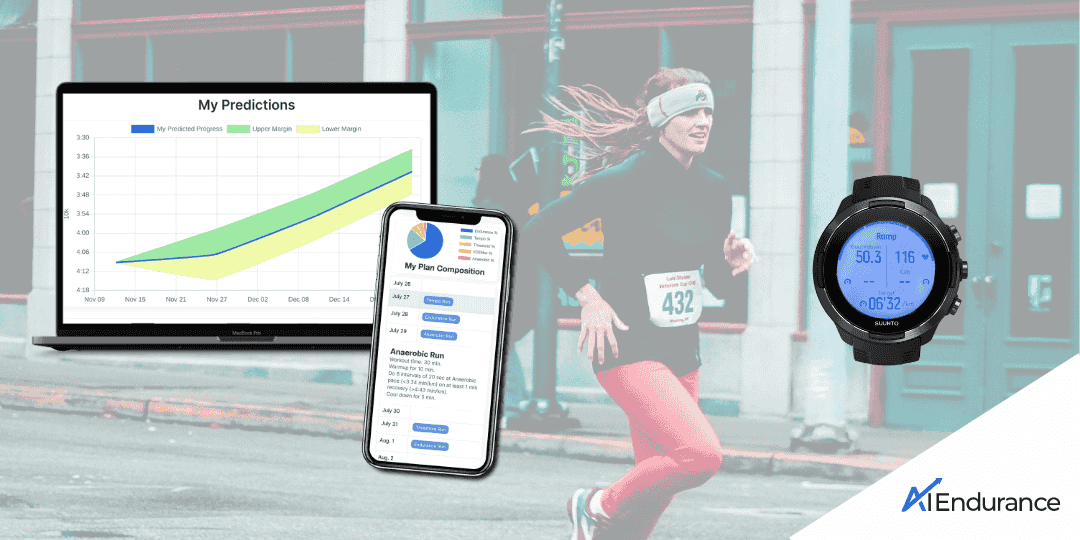
We show you in a few simple steps how to connect Suunto Guides with your AI Endurance account. You can get live workout instructions that are optimized to you by our AI. You can also easily determine your training zones and thresholds via a simple ramp test that utilizes your heart rate variability (HRV) data.
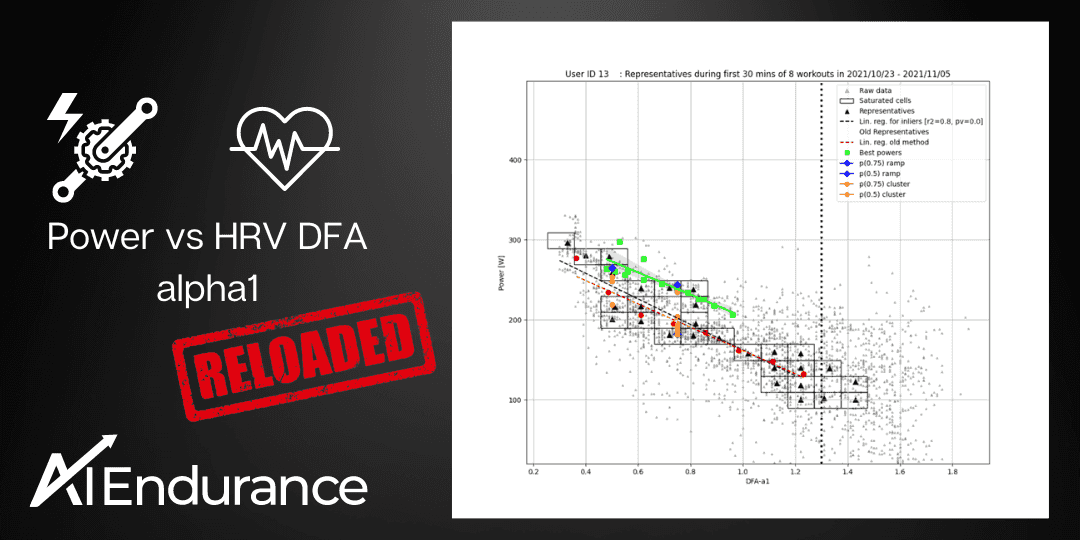
by Stefano Andriolo. Building on previous work, we refine a method to accurately determine the relationship between DFA alpha 1 and power. This method can be used to track fitness and thresholds of an athlete. We find in some cases ramp detection tends to overestimate thresholds, a finding mirrored in recent physiological papers. On the other hand, thresholds based on clustering of DFA alpha 1 values tend to agree well with this new method. We propose a hybrid lab and everyday workout experiment to further study the relationship.
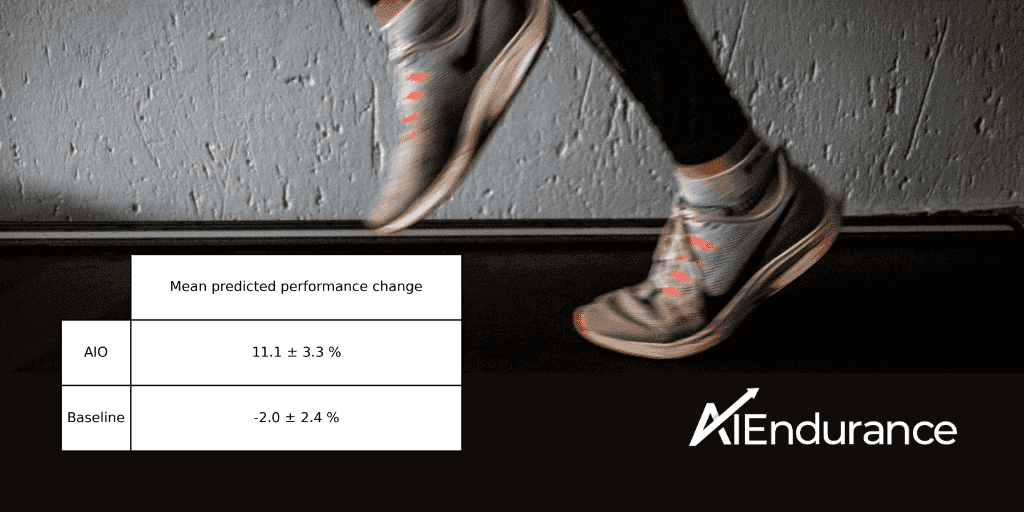
We compare polarized training, threshold training and AI optimized endurance training. AI optimized training yields the best results, followed by polarized training with threshold training in third. The results are inline with current exercise physiology research. If the training composition is not optimized to the individual athlete, substantially smaller gains are to be expected.
We recap the results of following AI Endurance’s cycling training plan that saw our FTP grow according to AI Endurance’s predictions, following the instructions on how to improve FTP.

